What counts as a built-in
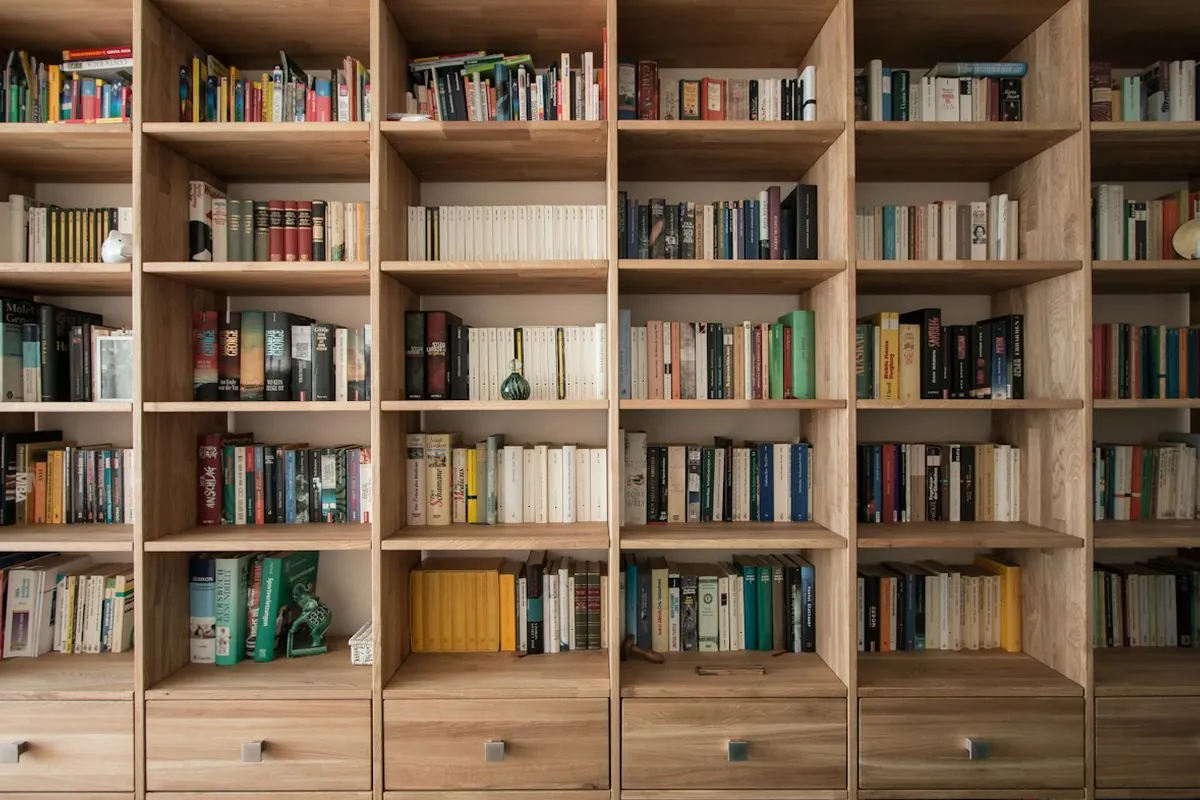
A built-in is cabinetry fixed permanently to the structure and scribed to the surfaces around it, so it reads as part of the building rather than as furniture standing against a wall. In practice that covers bookcases flanking a chimney breast, a full media wall, a window seat with drawers under it, a home office wall with a desk return, a bar or drinks cabinet, a mudroom bench with lockers over, and shelving in an awkward alcove that no freestanding unit will ever fit.
The defining characteristic, and the reason built-ins are a custom trade rather than a catalogue one, is that they end exactly where the wall does. A freestanding bookcase in a Mobile bungalow built in 1925 leaves a tapering gap down one side, because the wall leans. A built-in has a scribe cut to that lean and the gap disappears. That single detail is what people are paying for, and it is entirely invisible once it is done correctly.
Shelf spans, the thing that decides whether it lasts
Keep unsupported shelf spans to about 30 to 32 inches for 3/4 inch plywood or solid wood carrying books. Sag is proportional to span cubed, which is the reason a shelf that is double the length sags eight times as much rather than twice as much. It is also the reason a 48 inch shelf that looked perfectly fine empty in a showroom develops a permanent curve within a year of holding a row of hardbacks.
| Shelf construction | Comfortable span with books | Notes |
|---|---|---|
| 3/4 in plywood, plain edge | Up to about 30 in | The default. Beyond this, expect visible sag over time |
| 3/4 in plywood with a 1.5 in hardwood front edge | Up to about 42 in | The edge acts as a beam and is the cheapest stiffening there is |
| 1 in solid hardwood | Up to about 36 in | Heavier and more expensive; moves more than plywood in humidity |
| 3/4 in plywood with steel flat bar let into the underside | 48 in and beyond | Invisible once installed, and the answer for a long unbroken run |
| Particleboard or melamine shelving | Under 24 in | Sags reliably. Suitable for a garage or a closet, not for books |
Working spans used in cabinetmaking practice. Load matters more than material: paperbacks, hardbacks, vinyl records and ceramics are very different weights per foot.
Two other things follow from this. First, adjustable shelving on a drilled 32 millimetre system is almost always better than fixed, because the loads on a shelf change over a lifetime and a fixed shelf cannot respond. Second, a vertical divider is not just a design element: it halves the span either side of it, which is why a wall of bookcases in 30 inch bays outlasts the same wall in 48 inch bays by a very long way.
Media walls, and the three things that get retrofitted badly
Cable routing
Decide where the equipment lives and how the cables reach it before the unit is built. Grommets in the back panels, a chase behind the vertical dividers and a route from the television position down to the component shelf all cost nothing at build time. Drilling them afterwards means emptying the unit, working overhead through a 12 inch opening and accepting that the holes will be in approximately the right place rather than exactly.
Ventilation
An amplifier or a games console in a closed cabinet with no airflow will run hot and shorten its own life. The fix is simple: an opening at the bottom of the compartment and another at the top, or a slotted back panel, so convection does the work. In a Mobile living room, where the air conditioning is running for much of the year and the room is sealed, that airflow matters more than it does in a temperate climate.
The television mount
A wall-mounted television needs to reach solid framing or dedicated blocking, not just the back panel of a cabinet. If the mount lands in the middle of a built-in, blocking has to be built into the unit at the right height before the back goes on. This is the single most common thing people wish they had mentioned at the drawing stage.
Flanking a fireplace, and why the two sides are never the same
Bookcases either side of a chimney breast are the most requested built-in there is, and in any Mobile house of age the two alcoves are different widths. Chimney breasts are rarely centred on the wall, and a century of settlement in a raised cottage rarely leaves them plumb either. A matched pair bought as a set will therefore leave two different gaps.
The custom answer is to build the two units to their actual alcove widths and keep the visible elements identical: the same shelf heights, the same stile widths, the same reveal at the front. The eye reads the front face and the shelf lines, not the overall width, so two units 2 inches different in width look like a matched pair as long as everything visible aligns. Getting that right requires measuring both alcoves at several heights, which is one of the reasons a site measure is not optional.
Clearances to the firebox are set by the fireplace manufacturer and are not negotiable. Any built-in near a working fireplace needs those figures confirmed before it is drawn, and a gas fireplace being relocated is a separate trade entirely.
What built-ins cost in Mobile, AL
Price built-ins by linear foot like any other cabinetry. HomeAdvisor's national custom range is $500 to $1,200 per linear foot installed, updated 17 June 2026, and Thumbtack's 8 July 2026 figures put custom at $500 to $1,400 and up. Built-ins usually land in the lower half of those bands because they carry no plumbing, no appliances and often no countertop, though a media wall with a lot of doors and drawers can climb.
| Built-in | Linear feet | At $500 per ft | At $1,200 per ft |
|---|---|---|---|
| Single alcove bookcase | 3 ft | $1,500 | $3,600 |
| Pair flanking a chimney breast | 6 ft | $3,000 | $7,200 |
| Window seat with drawers | 5 ft | $2,500 | $6,000 |
| Full media wall | 10 ft | $5,000 | $12,000 |
| Home office wall with desk return | 12 ft | $6,000 | $14,400 |
Our arithmetic against HomeAdvisor's national per linear foot custom range, 17 June 2026. No Mobile-specific cabinet pricing dataset is published by anybody.
The cost guide lists every published figure with its publisher and date attached.
Before you commission a built-in
- Note what is in the wall: switches, outlets, vents, pipework and whether it is load bearing.
- Decide what the shelves will hold. Books, vinyl and ceramics are very different loads per foot.
- Measure the alcove at top, middle and bottom. In an older Mobile house those three numbers will differ.
- Decide the television position and mount type before anything is drawn, so blocking can go in.
- Check the doorway and stair the unit has to travel through, because it dictates module sizes.
- Confirm fireplace clearances from the appliance manufacturer if the unit goes near a firebox.
- Ask for adjustable shelving on a drilled system rather than fixed shelves.
Built-ins across Mobile and the Eastern Shore
Mobile's older neighbourhoods are full of the exact rooms built-ins were invented for: alcoves either side of a chimney, deep window reveals, tall ceilings with wasted upper wall, and no two walls parallel. Newer houses in Daphne, Fairhope and Spanish Fort tend to want media walls and home office runs instead, where the wall is straight and the job is about function and cable management.
Related work: closets and pantries, laundry and mudroom and the full service area. Start a measured quote on the contact page.