
Hardware is the part of a cabinet you interact with
You never touch a cabinet box. You touch the pull, the hinge and the slide, thousands of times a year each. That makes hardware the component with the highest ratio of daily experience to cost in the entire kitchen, and it is routinely left to the end of a specification and chosen from a photograph.
It is also the component that determines whether the finished job looks professional. A run of doors is judged on whether the pulls line up, and pulls that are individually measured will not line up, because measuring by eye across twenty doors accumulates error. Drilling from a jig that registers off a consistent reference edge is what produces a straight run, and it takes less time than measuring each one.
Hinges: the three adjustments that matter
Modern cabinet doors run on European concealed hinges, which sit in a 35 millimetre cup bore in the back of the door and clip onto a mounting plate on the cabinet. Their great virtue is that they adjust in three planes after fitting: side to side, in and out, and up and down. All three get set across the whole run rather than door by door, because a door aligned perfectly to the cabinet but not to its neighbour still looks wrong.
| Type | Use | Notes |
|---|---|---|
| Full overlay concealed | Doors that cover almost the whole frame | The default in contemporary work. Narrow reveals demand accurate setting |
| Half overlay concealed | Two doors sharing one partition | Needed wherever a single cabinet partition carries doors on both sides |
| Inset concealed | Doors sitting flush inside the opening | Least forgiving. The reveal is visible on all four sides |
| Soft close, integrated | Anywhere | Damper built into the hinge body. Cleanest solution |
| Soft close, clip-on damper | Retrofit to existing hinges | Cheapest way to add soft close to a kitchen you are keeping |
| Exposed butt or semi-concealed | Traditional and period work | Visible by design. Fewer adjustments, so the carpentry has to be right |
Hinge selection follows the overlay, which follows the face frame openings. On an existing kitchen the overlay is already fixed, so the hinge type is largely determined for you.
Drawer slides, and why full extension is worth the money
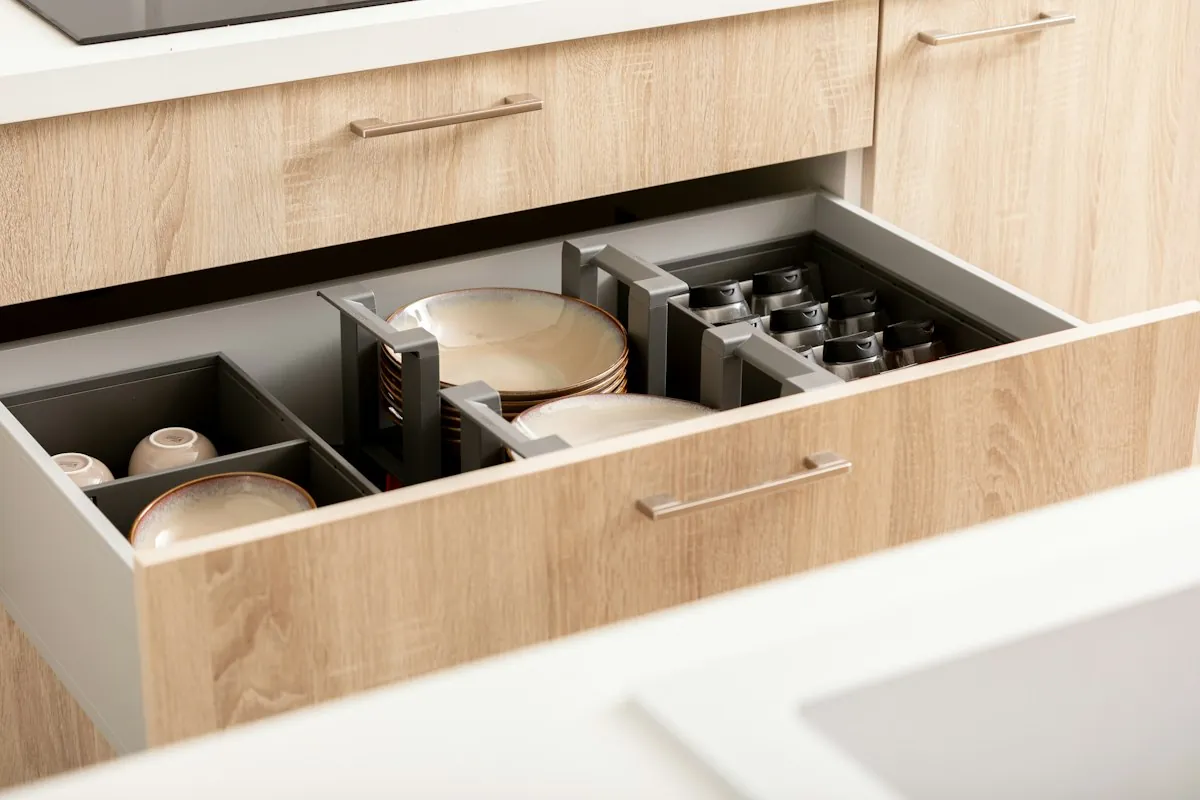
A three-quarter extension slide leaves roughly a quarter of the drawer inside the cabinet permanently. In a 24 inch deep drawer that is 6 inches of storage you own and cannot reach without pulling the contents forward. Full extension slides bring the whole box out, which effectively buys you that volume back for the price difference between two slide types.
Undermount slides go underneath the drawer box rather than at its sides, which means the drawer can be as wide as the opening and the slides are invisible when the drawer is open. Side-mount epoxy slides sit in the gap either side, costing about an inch of width, and they are the type most likely to be found in a kitchen from the 1980s or 1990s. Moving from one to the other usually needs a new drawer box, which is why it is normally paired with new doors and fronts or with refacing, when the fronts are off anyway.
Pull placement: consistency beats correctness
There is no building code for cabinet pull placement and no single right answer. What there is, is a convention that most kitchens follow and a rule that matters more than the convention.
| Component | Placement | Note |
|---|---|---|
| Upper door | On the bottom rail, aligned with the stile | Within reach without stretching |
| Lower door | On the top rail, aligned with the stile | Mirrors the uppers about the counter line |
| Standard drawer | Centred on the face | Single pull is fine up to about 30 in wide |
| Tall drawer | Centred in the upper third | Reads better than dead centre on a deep pan drawer |
| Wide drawer over 30 in | Two pulls, evenly spaced | A single pull racks a wide drawer in its slides over time |
| Appliance and pantry panel | Full-length or oversized pull | Matches the visual weight of the panel |
Convention rather than requirement. The rule that matters is that every pull is set out from the same reference edge, so the run reads straight.
Sizing
Match the pull length loosely to the piece it sits on. Three to four inch centres suit standard doors and small drawers, five to eight inches suit wide drawers, and twelve inches or more suits tall pantry and appliance panels. Oversized hardware used consistently throughout a kitchen reads as a deliberate choice. Used on some pieces and not others, it reads as a mistake.
Finish and corrosion on the Gulf Coast
Inland around Mobile and Saraland, hardware finish is essentially an aesthetic decision. Nearer the bay and down at Gulf Shores it becomes a durability decision, because salt in the air attacks any breach in a plated surface and plating on a cabinet pull is thin by design.
The durable options are solid stainless steel and solid brass, both of which corrode at the surface rather than through. Plated finishes over zinc alloy are the least durable in that environment, and matte black powder coats sit in between, depending entirely on the quality of the coating and whether it has been chipped. This applies with more force to hinges and slides than to pulls, because a seized slide is a functional failure and a tarnished pull is a cosmetic one.
For outdoor kitchen cabinetry the answer is marine-grade stainless throughout, without exception, because the exposure there is continuous rather than occasional.
Drilling, and the mistake you cannot undo
Cabinet doors are drilled after they are finished, which means every hole is permanent and every error is visible. Two techniques prevent almost all of the trouble.
- Drill from the show face with a solid backing block clamped behind, so any breakout happens on the hidden side.
- Use a jig that registers off a consistent edge rather than marking each door with a tape measure.
- Drill one door, offer up the pull, and check the position before drilling the other nineteen.
- Check the pull centres against the actual hardware rather than against the packaging, which is occasionally wrong.
- On drawers, check that the pull fixing screws are the right length for the front plus any sub-front, because a screw that is too long fouls the contents.
- Set every hinge adjustment across the whole run at the end, not door by door as you go.
What hardware costs, and why the pull choice drives it
No publisher produces a reliable national dataset for cabinet hardware on its own, so we are not going to print a figure. What is worth understanding is the arithmetic: hardware is a per piece cost multiplied by a larger number of pieces than people picture.
A kitchen of twenty doors and fifteen drawers needs thirty-five pulls, forty hinges and fifteen pairs of slides. That is ninety separate items. A pull that costs a few dollars more than another therefore moves the total by a meaningful amount, which is why the hardware line is the one most often revised after a first quote comes back. It is also why upgrading hinges and slides on a kitchen you are otherwise keeping is such good value: the labour is modest and the daily difference is large.
The cost guide carries every published cabinetry figure we could verify, each with its publisher and date.
Hardware work across Mobile County and Baldwin County
Hinge and slide upgrades on existing kitchens are the most common hardware-only request across the whole region, and they are the best value change available in a kitchen that is otherwise sound. Coastal properties in Gulf Shores and bay-adjacent sites in Fairhope and Daphne are where the corrosion question stops being theoretical.
Related: drawer fittings and organisation, the full service area, and the contact page for a quote.