What an outdoor kitchen is actually up against here
Mobile is one of the wettest cities in the country, and an outdoor kitchen sits in all of it. NOAA's 1991 to 2020 climate normals for Mobile Regional Airport record 66.15 inches of annual precipitation, with July at 7.25 inches and every month from November through September above 4.7 inches. The mean dew point reaches 72.0 degrees in mid-July. Anywhere near the bay or down toward the coast in Baldwin County, salt is in the air on top of that.
The federal guidance recognises the distinction. Wood Handbook FPL-GTR-282, Table 13-2, specifies interior woodwork in the damp warm coastal area at 11 percent moisture content and exterior siding, trim, sheathing and laminated timbers at 12 percent, with individual pieces running 9 to 14 percent. Those exterior figures assume exterior-rated material to begin with, which is the point people miss: the higher moisture target is not permission to use interior cabinets outdoors, it is a description of what exterior-grade material has to cope with.
The four materials that genuinely work outdoors
| Material | How it copes | Trade-offs |
|---|---|---|
| Marine grade plywood, fully finished | Waterproof adhesive throughout, void-free core | Needs a maintained exterior finish and sealed edges; the finish is the weak point, not the panel |
| Powder-coated aluminium | Does not rot, does not rust, indifferent to salt | Dents; limited door style options; a manufactured rather than joiner-built look |
| Stainless steel | Best corrosion resistance if the right grade is used near salt air | Expensive, shows fingerprints and water spots, gets hot in direct sun |
| Masonry or steel frame with doors fitted in | The structure is inert; only the doors are vulnerable | Not really cabinetry, so storage is what the block layout allows rather than what you design |
| Cabinet grade plywood, MDF, particleboard | Fails | Interior products in an exterior environment. Not worth installing at any price |
Assessment for the exposure described above: 66.15 in of annual rainfall, mean July dew point 72.0 F (NOAA 1991 to 2020 normals, Mobile Regional Airport), plus salt air near the bay and the coast.
The practical answer for most Mobile projects is either marine grade plywood with a properly maintained exterior finish, or a masonry island with exterior-rated doors set into it and joiner-built cabinetry only in the covered runs well away from the grill. Both are honest. What is not honest is ordinary cabinetry sold outdoors on the basis that the patio is covered.
Detailing for water getting in, not staying out
Outdoor cabinetry is designed on the assumption that water will get inside, because it will. The detailing is therefore about giving it somewhere to go rather than trying to seal it out permanently, which never works for long.
- A sloped cabinet base, so water runs to a low point rather than pooling in the middle.
- Weep holes or slots at that low point, kept clear of the structure behind.
- A ventilated gap between the back of the carcass and the wall or masonry, so air moves.
- Slatted or drilled shelves rather than solid panels, so nothing sits in standing water.
- No internal horizontal ledge that can hold a puddle, including at the bottom of a door rail.
- A drip detail at the bottom edge of every door, so runoff leaves the face rather than wicking under.
- Stainless or marine-grade hinges, slides and fasteners throughout, since ordinary plated hardware rusts fast near salt air.
- Every cut edge sealed, including the ones nobody sees, because those are the ones that fail first.
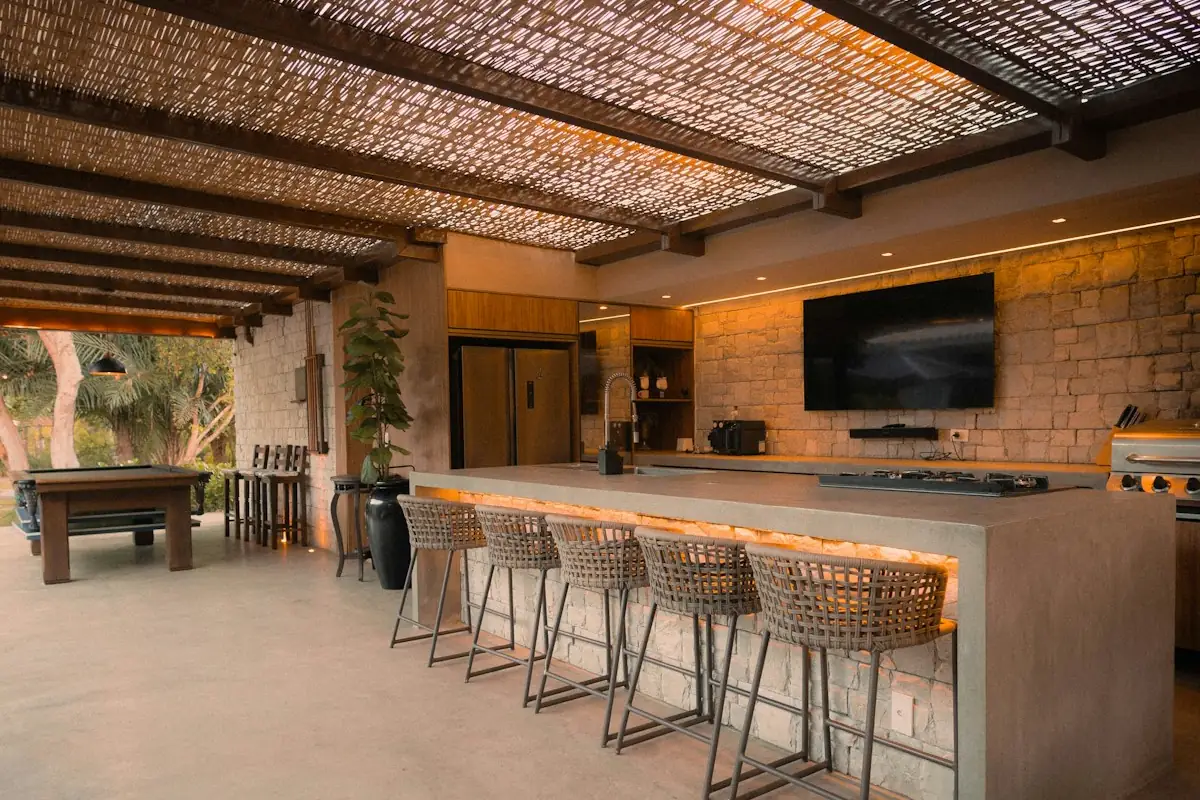
Appliances set the layout, not the other way round
Every built-in grill, side burner, outdoor refrigerator and ice maker publishes a cut-out dimension and a clearance to combustibles, and both are fixed. The clearance figure is the one that shapes the design, because it determines how close any wooden component can come to the appliance. In practice that often means the grill sits in a masonry or steel-framed section with cabinetry either side rather than around it.
Refrigeration outdoors
An outdoor-rated refrigerator is a different appliance from an indoor one, and putting an indoor unit into an outdoor cabinet is a common shortcut that ends badly. Outdoor units are built for ambient temperature swings and for the humidity, and they vent differently. The cabinet has to give that venting a clear path, usually at the front, which affects the toe kick detail.
Sinks and drainage
An outdoor sink needs supply, waste and, in most designs, a way to drain down for winter even in a climate as mild as this one. It is plumbing work, so it steps outside Mobile County's cabinetry permit exemption. It is also the component most often added later and most awkward to retrofit, so it is worth deciding before the structure is built.
Where the money actually goes
In an outdoor kitchen the cabinetry is usually not the largest line. Appliances, the structure itself, the countertop and the gas, electrical and plumbing trades typically add up to more than the cabinets do. That is a useful thing to know before budgeting, because it means the right question is not how to economise on the cabinetry but whether the project scope is right.
There is no published dataset for outdoor kitchen cabinetry specifically. As a reference point, HomeAdvisor's national installed figures for custom cabinetry, updated 17 June 2026, run $500 to $1,200 per linear foot, and Thumbtack's 8 July 2026 figures put custom at $500 to $1,400 and up. Exterior-rated materials sit at or above the top of those bands, because marine grade plywood, stainless hardware and exterior finish systems all cost more than their indoor equivalents.
| Element | Typical share | Notes |
|---|---|---|
| Appliances | Large | Grill, refrigeration, side burner, ventilation if enclosed |
| Structure | Large | Masonry, steel frame or a framed and clad island, plus any roof |
| Countertop | Moderate | Stone or concrete, and it has to be an exterior-suitable material |
| Cabinetry and doors | Moderate | Exterior-rated throughout, including hardware |
| Gas, electrical, plumbing | Moderate to large | Permitted trades, and the lines most often underestimated |
Relative ordering based on how these projects are normally scoped. No published dataset breaks outdoor kitchen costs down by element for Mobile, Alabama or nationally.
The cost guide sets out every published cabinetry figure we could verify, with the publisher and date attached to each one.
Permits, which outdoor kitchens really do need
The cabinetry itself is exempt. Mobile County Inspection Services states that almost any work in Mobile County requires a permit and then lists exceptions including installing new cabinetry. Everything else in an outdoor kitchen falls outside that list: running a gas line, adding electrical circuits, installing a sink and drain, and building any roof or structure. Coastal Baldwin County adds wind-load design considerations to new structures.
Addresses inside the City of Mobile permit through Build Mobile. Daphne, Fairhope, Spanish Fort and Saraland each run their own building department. The permit and licensing guide links every one of them and quotes the county's own wording in full.
Outdoor kitchens across Mobile County and Baldwin County
Covered patios and pool houses are the common format inland around Mobile and Saraland. Across the bay, Daphne, Fairhope and Spanish Fort add bay-adjacent sites where salt is a genuine factor in hardware selection. Down at Gulf Shores salt exposure is the dominant constraint and stainless or aluminium becomes the sensible default rather than an upgrade.
Related: garage cabinets shares the unconditioned-air problem, kitchen islands covers the same clearance thinking indoors, and the service area page lists the full footprint. Start at contact.