One principle underneath all of it
Every fitting is a trade: you give up some interior volume and you gain access to the rest. The question for each one is whether the volume you lose is worth the access you gain, and the answer depends almost entirely on how deep the cabinet is and how often you reach into it.
A deep base cabinet is the strongest case for fittings, because 24 inches of depth behind a door is where things go to be forgotten. A wall cabinet is the weakest, because you can see the whole shelf from standing and reach most of it. That single distinction sorts most of the list below.
Drawers versus doors, decided properly
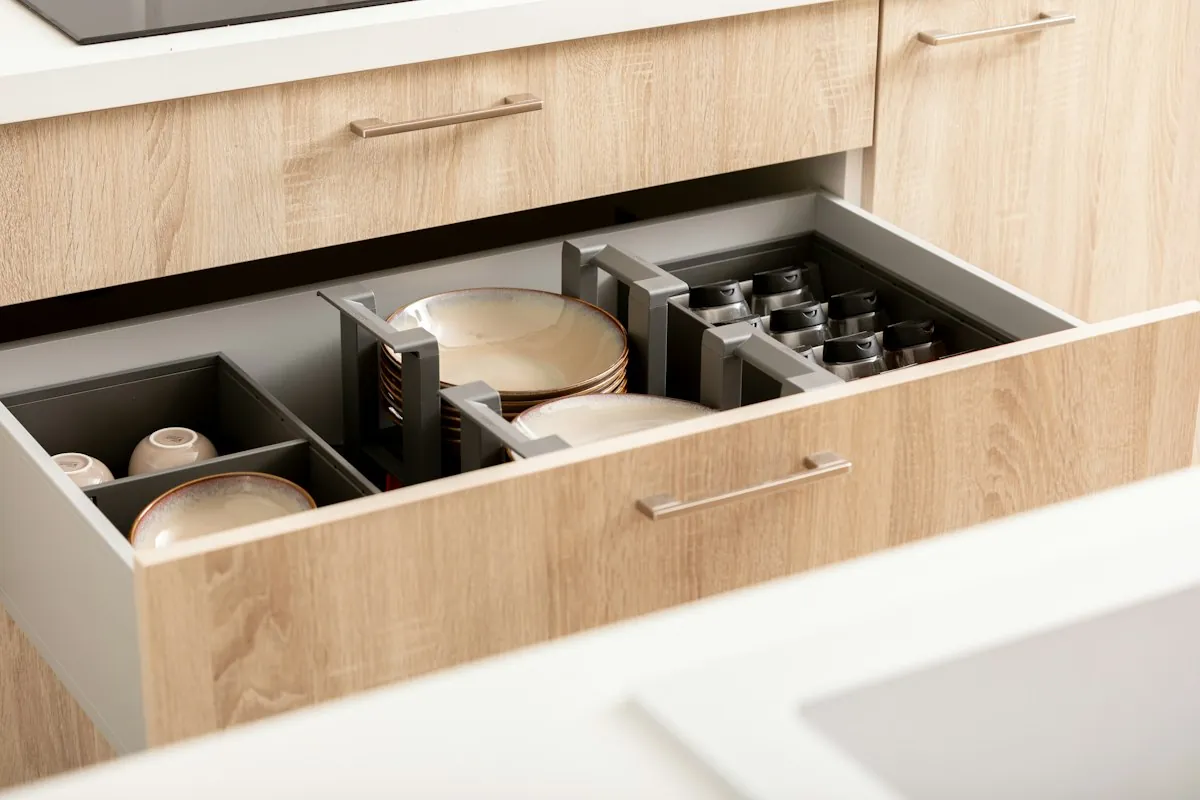
In base cabinets, drawers beat doors with shelves almost every time. A 30 inch wide three-drawer bank holds more usable, reachable volume than a 30 inch cabinet with a door and a shelf, because nothing is lost at the back and nothing has to be moved to reach anything else. Drawers also let one person unload a dishwasher without kneeling, which is a small thing that happens several hundred times a year.
There are two genuine exceptions. Tall items, such as bottles and stockpots, suit a door with adjustable shelving better than a fixed drawer depth. And cabinets housing appliances or plumbing obviously have to be doors. Everything else is a drawer candidate.
| Internal depth | Suits | Notes |
|---|---|---|
| 4 to 5 in | Cutlery, utensils, wraps, small tools | The top drawer of almost every bank |
| 6 to 8 in | Plates, bowls, food storage containers | Wants pegs or dividers if it is holding crockery upright |
| 10 to 12 in | Pots, pans, mixing bowls | The workhorse drawer; the one that fails first if the box is stapled |
| 14 in and above | Stockpots, small appliances | Heavy when loaded; full extension undermount slides matter most here |
Internal depths, not cabinet heights. A deep pan drawer loaded with cast iron is the single heaviest thing in a kitchen and the reason drawer box construction is worth naming on a quote.
The fittings that earn their place
The pull-out waste unit
If you fit one thing, fit this. A pull-out bin unit in a base cabinet beside the sink keeps the bin out of the room, keeps the smell inside a closed cabinet, and makes scraping plates a one-handed operation. Double units with a recycling side are worth the extra width where the run allows. It is the fitting with the highest daily use rate of anything in this guide.
Roll-out shelves in deep base cabinets
A roll-out converts a cabinet you reach into blind into a shelf that comes to you. The cost is roughly an inch of width and an inch of height per roll-out for the slides and clearances, and in a 24 inch deep cabinet that trade is obviously worth making. Two roll-outs in a 24 inch base cabinet is the standard arrangement and it is hard to regret.
Divided cutlery and utensil drawers
Dividers in the top drawer of every bank. The reason to specify them with the cabinets rather than buying trays afterwards is fit: a made-to-size divider uses the full internal width, and a bought tray leaves a two inch gutter down one side that fills with everything that does not have a home.
Corner mechanisms
A blind corner cabinet extends sideways behind the neighbouring run, and without a mechanism the back third is genuinely unreachable. Corner pull-outs are among the most expensive fittings per cabinet and also the easiest to justify, because the comparison is access against no access rather than convenience against cost. If your kitchen has a blind corner and no mechanism, that is usually the single largest volume of dead storage in the room.
Soft close
Soft close comes from the hinge and the slide, not from the door, which means it can be added to an existing kitchen without replacing anything visible. Either swap the hinges for soft close versions or clip dampers onto the existing ones. It is among the cheapest changes available in a kitchen and among the most noticed, because it changes how the room sounds. The hardware page covers the mechanics.
The fittings that depend entirely on you
| Fitting | Worth it if | Skip it if |
|---|---|---|
| Tray and baking sheet dividers | You own several trays and bake regularly | You own two trays and stack them fine |
| Pull-out spice rack | Your spices are already in uniform jars | Your spices are in the manufacturers' packaging |
| Under-sink pull-out | The plumbing allows a U-shaped tray around the trap | The trap sits dead centre and leaves nothing usable |
| Drawer peg systems for crockery | You want plates in a drawer rather than a cabinet | Your plates live in a wall cabinet and always will |
| Appliance garage | You have three or four small appliances used daily | You have one kettle |
| Pull-out pantry tower | The kitchen has no walk-in pantry and a spare 12 to 18 in | You have a walk-in pantry already |
| Lift-up or bi-fold wall cabinet doors | Ceilings are high and a swinging door would be in the way | Standard ceilings, where a normal door is simpler and cheaper |
These are the fittings that genuinely split the room. The ones in the table above them are close to universally useful.
The fittings people quietly stop using
This is the section most guides leave out, and it is the one that saves money. These are fittings that are frequently specified, frequently installed and then frequently ignored after the first year.
- Wine racks built into a kitchen run, which hold six bottles and take the space of a drawer.
- Tilt-out sink front trays, which hold a sponge and cost a cabinet detail.
- Dedicated cutting board slots, because the board ends up on the counter anyway.
- Plate racks above a counter, which look excellent and hold dust in a humid kitchen.
- Fixed spice drawers sized to one brand of jar, which stop working the moment you change brands.
- Pull-out towel rails inside a cabinet door, which are always in the way of whatever is behind them.
None of those is a bad product. They are simply fittings that solve a problem most households do not have, and each one is a drawer or a shelf you could have had instead.
The hardware underneath the fittings
Every fitting in this guide runs on a slide or a mechanism, and the quality of that mechanism determines whether the fitting is still pleasant to use in five years. Three specifications are worth naming on the quote.
| Specification | Better | Worse |
|---|---|---|
| Slide extension | Full extension, the whole box clears the cabinet | Three-quarter extension, a quarter of the drawer stays inside |
| Slide mounting | Undermount, invisible and full width | Side-mount epoxy, costs an inch of width and shows |
| Weight rating | Rated for the load, especially on deep pan drawers | Unrated, which fails on the heaviest drawer first |
| Damping | Soft close integrated into the slide or hinge | None, which is what loosens fronts over years |
| Corrosion resistance | Stainless or well-coated steel near the coast | Plated steel, which salt attacks at every breach |
The corrosion row applies particularly to bay-adjacent properties and to Gulf Shores. Inland around Mobile and Saraland it is less critical.
Two Gulf Coast considerations
Fittings are largely climate-neutral, with two exceptions worth knowing.
First, corrosion. Salt attacks any breach in a plated finish, and that applies to a drawer slide and a corner mechanism exactly as it applies to a visible pull. On a coastal or bay-adjacent property, specify stainless or properly coated mechanisms. A seized slide is a functional failure rather than a cosmetic one, which makes it the more expensive kind.
Second, airflow. A fitting that completely seals a cabinet interior against an exterior wall is doing the wrong thing in a climate where NOAA records 66.15 inches of annual rainfall and a mean July dew point of 72.0 degrees. That is not an argument against fittings, it is an argument against sealed, stagnant volumes: leave a gap at the back, avoid a fully lined interior against an exterior wall, and remember that a louvred door exists for exactly this reason. The materials guide covers the underlying figures.
Zoning a kitchen before choosing any fitting
The fittings work far better when the kitchen has been zoned first, and zoning costs nothing. The idea is simply that things live near where they are used rather than near where there happened to be space.
| Zone | Where it is | What lives there | Fittings that suit |
|---|---|---|---|
| Consumables | Near the refrigerator and pantry | Food, dry goods, drinks | Roll-outs, a pull-out pantry tower, deep drawers |
| Non-consumables | Near the dishwasher | Crockery, glassware, cutlery | Divided drawers with pegs, a shallow top drawer |
| Cleaning | Under and beside the sink | Bin, detergents, cloths, brushes | Pull-out waste unit, a U-shaped under-sink tray |
| Preparation | The largest clear run of counter | Boards, knives, bowls, small appliances | Deep drawers, a knife block insert, an appliance garage |
| Cooking | Around the range | Pans, utensils, oils, seasonings | Deep pan drawers, a utensil crock, a narrow pull-out |
A standard kitchen zoning approach. The value is that it tells you which fitting belongs in which cabinet before you start choosing accessories.
Run this exercise before specifying anything and two things happen. Fittings get chosen for the cabinet they are actually in, rather than scattered across the kitchen. And several fittings turn out to be unnecessary, because the zone already solved the problem the fitting was supposed to solve.
Lighting, which is a fitting people forget to specify
Under-cabinet lighting changes a kitchen more than most of the accessories on this page, and it is cheapest to install when the cabinets are being made or are open for other work. Three points are worth deciding at drawing stage.
Position matters more than brightness. A strip fitted toward the front edge of the wall cabinet's underside lights the counter; a strip fitted at the back lights the splashback and throws a shadow where you are actually working. The front position is almost always right.
Interior lighting in glass-front cabinets is the second decision, and it is what makes a mullion door worth having rather than simply a hole in a run. It also needs the cabinet interior to be finished properly, which is a cost line rather than an afterthought.
The third is switching. A light that shares a switch with the room's main lighting is effectively decorative; one on its own switch or a dimmer gets used every evening. Both require a circuit, which is electrical work and therefore outside Mobile County's cabinetry permit exemption, so it belongs in the plan early.
Fitting these to cabinets you already have
Most of this guide can be retrofitted, and the cheapest moment to do it is when the doors are already off for another reason. A refacing job, a doors and fronts job or a painting job all open every cabinet in the kitchen, and adding roll-outs, a waste unit, dividers and soft close at that point costs a fraction of what it does as a separate visit.
- Roll-out shelves in every base cabinet deeper than about 18 inches.
- A pull-out waste unit in the cabinet beside the sink.
- Soft close hinges or clip-on dampers throughout.
- New dovetailed drawer boxes on full extension undermount slides, replacing stapled boxes.
- Made-to-size dividers in the top drawer of each bank.
- A corner mechanism in any blind corner, which is where the dead volume is.
- Drilling for adjustable shelving where the existing shelves are fixed.
For a new kitchen, the same list goes on the drawing rather than being added later, and the kitchen cabinets page covers how that fits into the wider specification. Start a measured quote at contact.