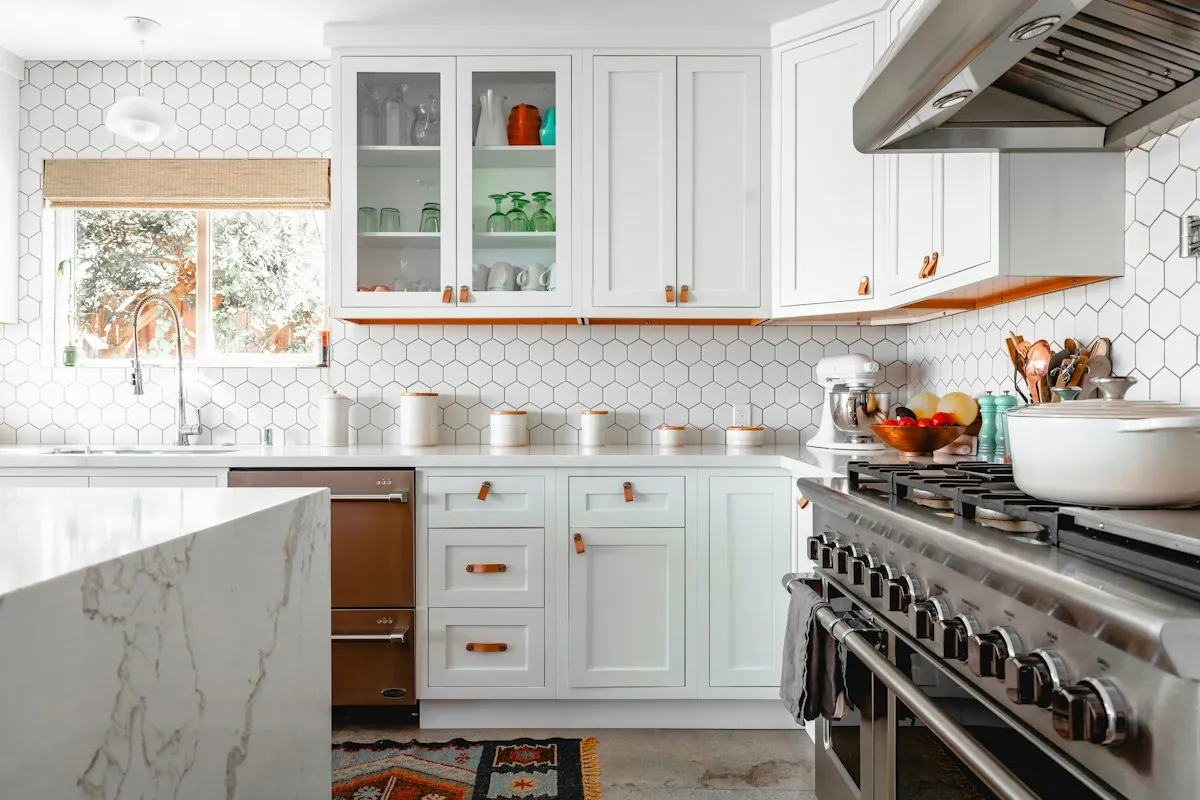
The definition, stripped back
Stock cabinets are manufactured in fixed sizes and held in inventory. The widths almost always step in 3 inch increments, from 9 inches up to 48, and the depths and heights are fixed. You choose from what exists.
Semi-custom cabinets are built to order from a manufacturer's catalogue, with modifications permitted inside rules the manufacturer publishes. Typically that means depth changes, height changes, a wide finish and door style range, and sometimes width adjustments in smaller increments. You choose from what the catalogue allows, and the catalogue allows a lot.
Custom cabinets are drawn to your room, with the parts cut for your dimensions. There is no catalogue, so there is no rule about what is possible beyond physics and budget. You choose the dimensions.
Tier is not quality, and conflating them costs money
The most expensive misunderstanding in this whole subject is the belief that custom means well made and stock means badly made. Tier describes flexibility of dimension. It says nothing about what the box is made of or how the drawer is joined.
There is genuinely good stock cabinetry with plywood carcasses, dovetailed drawer boxes and full extension undermount slides. There is genuinely poor custom work with particleboard boxes, stapled drawers and side-mount epoxy slides, sold at custom prices because somebody cut the parts on site. The questions that determine quality are the same at all three tiers.
| Question | Better answer | Worse answer |
|---|---|---|
| What is the carcass made of? | Plywood, especially at wet locations | Particleboard everywhere including sink bases |
| How are the drawer boxes joined? | Dovetailed or doweled solid wood or plywood | Stapled butt joints |
| What slides are fitted? | Full extension undermount | Three-quarter extension side-mount epoxy |
| What hinges? | Six-way adjustable concealed, soft close | Basic concealed, no damping |
| How is it finished? | Sprayed catalysed finish, cured before delivery | Site-applied, or rushed between coats |
| What is the shelf material and span? | Plywood or solid, span under about 32 in | Particleboard over a long span |
None of these rows is determined by tier. Ask them of a stock supplier, a semi-custom supplier and a custom shop alike.
The filler strip test
This is the practical way to decide, and it takes two minutes with a tape measure.
- Measure your longest kitchen wall at floor level, wall to wall, in inches.
- Measure the same wall at counter height, about 36 inches up.
- Measure it again near the ceiling.
- Subtract the openings the appliances need: typically 30 or 36 inches for a range, 24 for a dishwasher, 33 to 36 for a refrigerator.
- Look at what is left, and look at whether your three measurements agree.
If the three measurements agree within about half an inch and the remaining run divides reasonably into 3 inch steps, stock or semi-custom cabinetry will fit with narrow fillers and you will not notice the compromise. If the three measurements disagree, or if the remainder leaves you needing a 5 inch or 9 inch piece of nothing at one end, that is the cost of stock cabinetry made visible. You pay it either way: in custom cabinet widths, or in filler strips.
In Mobile's older neighbourhoods, in the historic parts of Fairhope and in the mid-century housing around Saraland, the three measurements routinely disagree. In newer subdivision housing in Daphne and Spanish Fort, they usually agree. That is the single biggest geographic pattern in this market.
What each tier costs
| Tier | HomeAdvisor, 17 Jun 2026 | Thumbtack, 8 Jul 2026 | Materials only, HomeAdvisor |
|---|---|---|---|
| Stock | $100 to $300 | $75 to $400+ | $50 to $100 |
| Semi-custom | $150 to $650 | $150 to $900+ | $75 to $400 |
| Custom | $500 to $1,200 | $500 to $1,400+ | $300 to $750 |
Both publishers state these as national figures. The materials-only column shows why installation and labour are roughly 30 to 40 percent of a custom job and a smaller share of a stock one.
| Tier | Low end | High end |
|---|---|---|
| Stock | $2,500 | $7,500 |
| Semi-custom | $3,750 | $16,250 |
| Custom | $12,500 | $30,000 |
Our arithmetic against HomeAdvisor's published national per linear foot ranges, 17 June 2026. The full working, including other kitchen sizes, is in the cost guide.
Two things are worth noticing in those tables. First, the semi-custom band is enormous, stretching from close to stock pricing to close to custom pricing, which means the word semi-custom tells you very little about price on its own. Second, the gap between semi-custom and custom is the largest single step, which is why the filler strip test matters: it tells you whether you need to take that step.
Full detail and every published figure with its date is in the cost guide.
Where each tier stops being able to help
Stock
Stock runs out of road at any non-standard dimension. An 89 inch wall, a 9 foot ceiling you want to reach, a sink base under an off-centre window, a peninsula that has to finish exactly at a doorway. It also runs out at depth: if you want a 15 inch deep base cabinet in a tight galley, or a 27 inch deep one to gain counter space, stock generally cannot.
Semi-custom
Semi-custom runs out at the edges of the manufacturer's rules, and those edges are not always where you expect. Depth and height modifications are usually generous. Width modifications are often limited or expensive. Unusual assemblies, such as a cabinet built around a structural post or a run that steps in depth halfway along, are typically outside the system entirely. The honest way to find the edge is to describe the awkward part of your room to the supplier and ask directly.
Custom
Custom runs out at budget, and at the shop's own capability. Not every shop calling itself custom can spray a catalysed finish in a controlled space, build dovetailed drawer boxes, or produce a consistent inset reveal. The custom cabinets page lists what to check on the quote.
The Gulf Coast question cuts across all three
None of the three tiers is inherently better suited to this climate, and that is worth saying because it is sometimes implied otherwise. What matters is the specification, and any tier can carry a good one or a poor one.
The USDA Forest Products Laboratory recommends an in-service moisture content of 11 percent for interior woodwork in the damp, warm coastal area against 8 percent across most of the United States, and NOAA's 1991 to 2020 normals for Mobile Regional Airport record a mean dew point of 72.0 degrees in mid-July against 39.4 in mid-January. The consequences are plywood at every sink base, lower-movement species on wide panels and end grain sealed throughout, as set out in the materials guide.
Many semi-custom lines offer a plywood box upgrade and a choice of species, and some stock lines do too. The question to ask any supplier at any tier is the same: what is the carcass made of at the sink base. If the answer is particleboard, the tier is not the problem.
A decision path
| What the test showed | Tier that fits | Why |
|---|---|---|
| Square room, run divides into 3 in steps, standard ceiling | Stock or semi-custom | The catalogue sizes fit, so the flexibility premium buys nothing |
| Square room but non-standard depths or a tall ceiling to reach | Semi-custom | Depth and height modifications are exactly what semi-custom is for |
| Measurements disagree by more than half an inch | Custom | Scribes, tapered fillers and cabinet widths that suit the actual wall |
| Awkward features: structural post, off-centre window, stepped depth | Custom | Outside the rules of any catalogue system |
| Rental or flip, standard room, tight budget | Stock | Flexibility you will not use is flexibility you should not buy |
| Historic house, inset doors wanted | Custom | Inset needs consistent openings, which means building to the room |
Based on the filler strip test above. The one factor that overrides all of it is the condition of the existing boxes, since a sound box points toward refacing rather than any new tier at all.
One more path is worth naming: if the existing cabinet boxes are sound and the layout works, the right answer may be none of the three. Refacing or painting both sit below stock cabinetry in cost, and the refacing versus replacing guide has the four tests that decide it.
Lead time and availability by tier
The three tiers behave differently on time as well as on price, and the pattern is not simply that cheaper is faster.
Stock cabinets are held in inventory, so availability is usually immediate for common sizes and finishes. What catches people out is that the less common sizes in a stock range are frequently not actually stocked, which turns part of a stock order into a wait while the rest sits in a garage.
Semi-custom is built to order, so there is always a manufacturing lead time, but it is a production line and therefore predictable. A semi-custom supplier can generally tell you a date and hold it, which for a household trying to coordinate a plumber and a countertop fabricator is worth something on its own.
Custom depends entirely on the individual shop's backlog, which is why the honest answer to how long it takes is a question about the shop rather than about the tier. A shop with two weeks of work ahead of it and a shop with four months of work ahead of it are selling the same product on very different timelines. The timeline guide sets out the stages and what governs each.
| Tier | Lead time | Predictability | Changing your mind mid-project |
|---|---|---|---|
| Stock | Immediate for common sizes | High, unless a size is not really stocked | Easy; swap a box for another box |
| Semi-custom | A production lead time, but a stated one | High; a date can usually be held | Possible before the order is released, expensive after |
| Custom | Depends entirely on the shop's backlog | Depends on the shop | Free before drawing approval, costly after the parts are cut |
The single most important date in a custom project is drawing approval, because that is when the parts get cut to those dimensions.
Mixing tiers in one kitchen
Nothing requires a whole kitchen to come from one tier, and mixing is a genuinely underused strategy in rooms that are mostly square with two or three awkward spots.
The usual arrangement is semi-custom for the standard runs and custom for the parts that refuse to cooperate: an odd-width cabinet between a window and a wall, a tall unit built to a non-standard ceiling height, an appliance surround built to an appliance that does not match any catalogue opening, or an island sized exactly to the aisles the room can support.
The one thing that has to be controlled is matching. Door profile, overlay, species and finish have to line up across the two sources, and finishing in the same batch is the only reliable way to achieve that on stained work. In practice the workable version is a custom shop making the awkward pieces and finishing everything, including the semi-custom boxes' doors, in one run. Mixing two finished products from two suppliers and hoping the colours agree is the version that disappoints.
What to do next
Run the filler strip test on your longest wall. Write down the three measurements. Then either take those numbers to a supplier at the tier the table points you to, or get the room measured properly, which is what settles it definitively.
See kitchen cabinets for how a full kitchen job runs, the cost guide for every published figure, or contact for a measured quote.