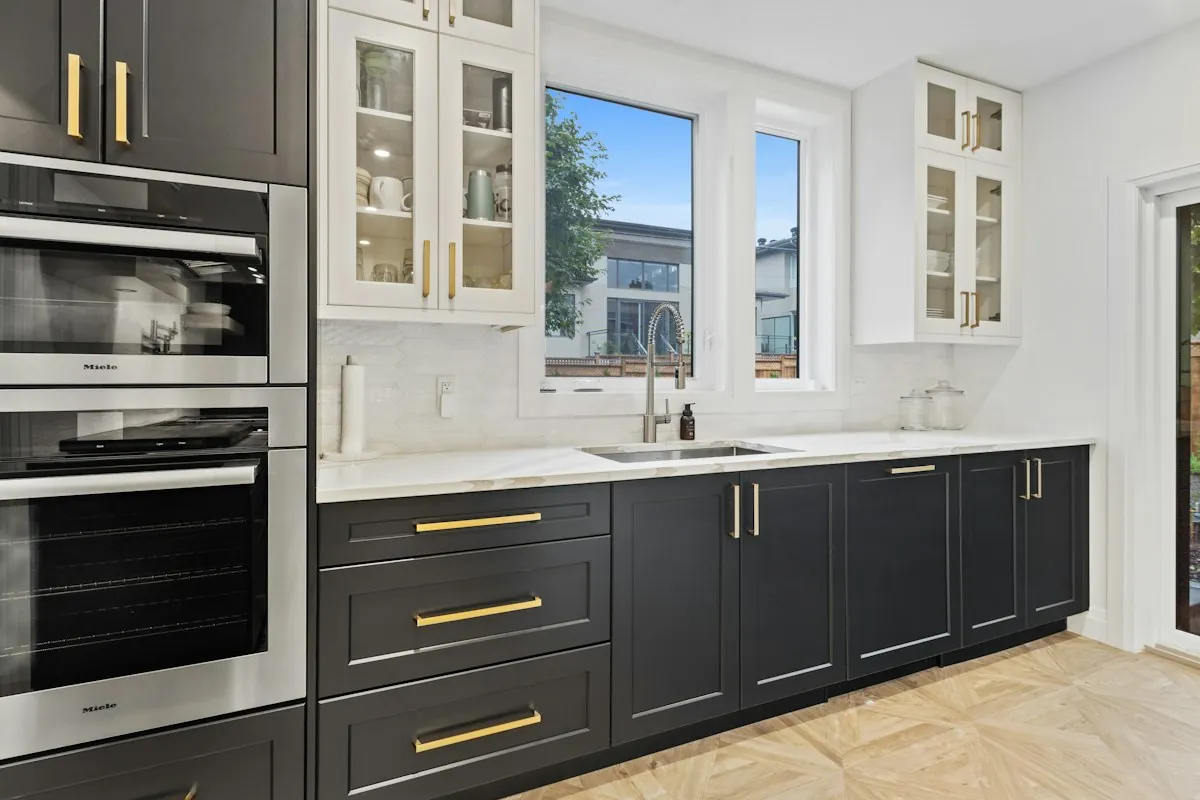
What custom cabinets in Mobile, AL actually are
A custom cabinet is one whose dimensions were decided by your room rather than by a manufacturer's catalogue. That is the whole definition, and everything else that gets sold under the word custom is a variation on how much of the catalogue survives. Stock cabinets arrive in fixed widths, almost always in 3 inch increments, and the installer makes up the difference with filler strips. Semi-custom cabinets start from that same catalogue but allow modifications to depth, height, finish and sometimes width, inside rules the manufacturer publishes. Custom cabinets have no such rules, because the shop is cutting the parts rather than ordering them.
In Mobile that distinction carries more weight than it does in a newer market. The city had 187,041 residents at the 2020 census and a housing stock that runs from antebellum and Victorian downtown through streets of raised cottages and craftsman bungalows under live oaks, out to post-war ranches and then to the newer subdivisions across the bay in Baldwin County. The older half of that has settled, been re-levelled, been through storms and been remodelled at least once. Walls lean. Floors slope. Ceiling heights change between rooms in the same house. A cabinet run built to nominal dimensions does not meet any of that gracefully.
The second half of what custom means here is the specification, not the dimensions. The USDA Forest Products Laboratory's Wood Handbook, publication FPL-GTR-282, publishes recommended in-service moisture content for interior woodwork by region. Most of the United States sits at 8 percent average with individual pieces running 6 to 10 percent. The dry south-west sits at 6 percent. The damp, warm coastal area, which the Handbook's own map draws along the Gulf and lower Atlantic and which contains Mobile, sits at 11 percent, with individual pieces running 8 to 13 percent. Cabinet-grade hardwood and softwood for furniture, cabinetry and millwork is normally kiln dried to 6 to 8 percent. The gap between those two numbers is the entire Gulf Coast cabinet problem in one line.
How much a cabinet panel actually moves in Mobile
You can calculate it, and the Wood Handbook gives you the formula. Equation 13-3 says the change in dimension equals the starting dimension multiplied by a species-specific dimensional change coefficient multiplied by the change in moisture content, valid anywhere between 6 and 14 percent. Table 13-5 publishes the coefficient for every commercial species in both the radial and the tangential direction, which is the difference between quartersawn and flat-sawn material.
Take a 24 inch wide flat-sawn door panel and move it from the 7 percent it left the kiln at to the 11 percent this coastline recommends. In sugar maple, tangential coefficient 0.00353, that panel changes by 24 x 0.00353 x 4, which is 0.339 inch, or about eleven thirty-seconds. In black cherry, coefficient 0.00248, it changes by 0.238 inch. In southern magnolia, 0.00230, it changes 0.221 inch. In American beech, 0.00431, it changes 0.414 inch. Same room, same season, same four points of moisture, and nearly double the movement between the best and worst choices on that short list.
| Species | Tangential coefficient | Movement across 24 inches |
|---|---|---|
| Southern magnolia | 0.00230 | 0.22 in |
| Black cherry | 0.00248 | 0.24 in |
| Black walnut | 0.00274 | 0.26 in |
| Yellow poplar, paint grade | 0.00289 | 0.28 in |
| Northern red oak | 0.00304 | 0.29 in |
| Sugar maple | 0.00353 | 0.34 in |
| White oak | 0.00376 | 0.36 in |
| American beech | 0.00431 | 0.41 in |
Coefficients from USDA Forest Products Laboratory, Wood Handbook FPL-GTR-282, Table 13-5. Movement calculated with the Handbook's own Equation 13-3. Quartersawn material of the same species moves roughly half as much, because the radial coefficient is lower.
Nobody is suggesting you pick a species on this basis alone. Grain, colour, cost and availability all matter. What the table does say is that a shop putting 24 inch flat-sawn beech panels into an inset door in Mobile has made a decision, whether or not they know it, and the customer finds out in August. The wood species guide runs the same arithmetic across every species worth considering.
Mobile's climate, in numbers rather than adjectives
NOAA's 1991 to 2020 climate normals for Mobile Regional Airport give the measurements that drive all of this. The annual precipitation normal is 66.15 inches and the annual mean temperature is 67.2 degrees. July is the wettest month at 7.25 inches and October the driest at 3.69. The figure that governs wood, though, is the dew point, because dew point is a direct statement of how much water the air is carrying. The hourly normals put the mean dew point on 15 January at 39.4 degrees, on 15 April at 54.8, on 15 July at 72.0 and on 15 October at 57.6.
That is a 32.6 degree swing between mid-winter and mid-summer, and a wooden door has no opinion about whether to respond to it. Air conditioning pulls the indoor number back down, which is why the Forest Products Laboratory is careful to note that its recommended values assume well ventilated buildings without unusual moisture sources and without air conditioning, and that in air-conditioned buildings the result depends largely on the equipment being correctly sized. A Mobile house that is closed up and conditioned all summer sits closer to the national 8 percent figure. A beach house on the Baldwin County coast that is shut up unconditioned between visits does not.

How we build a custom cabinet for a Mobile house
The build sequence below is the one every job follows. It is written out in full because the stages are where the cost sits, and because a homeowner who knows the stage list can tell the difference between a quote that covers the work and a quote that covers the cabinets.
Boxes
Carcasses are built from plywood or MDF depending on location. Plywood goes at every sink base, in any cabinet on an exterior wall, and anywhere a dishwasher or icemaker line runs. It handles a slow leak without turning to porridge, which particleboard does not, and a soft sink base is the most common single reason a coastal Mobile County kitchen ends up replaced rather than refaced. MDF is flatter than plywood and takes paint better, so it earns its place on painted doors and on wide flat panels where a plywood core would telegraph its grain through the finish.
Face frames or frameless
Framed construction puts a hardwood frame on the front of the box, which stiffens it and gives the hinge something solid to land on. Frameless, sometimes called full access, drops the frame and hangs the door directly off the box side, which buys you roughly 10 percent more usable volume and a cleaner interior. HomeAdvisor prices frameless at around a 15 percent premium over framed nationally, and inset doors at around a 20 percent markup over comparable traditional styles. In a Mobile house with leaning walls, framed construction is marginally more forgiving because the frame gives the scribe something to bite into.
Doors and drawer fronts
Door style and overlay are two separate decisions that people routinely collapse into one. Style is slab, shaker, recessed panel, raised panel, mullion or louvre. Overlay is full, partial or inset, and it describes how much of the face frame the door covers. Inset looks the best and costs the most, and it is the option least forgiving of seasonal movement, because an inset door lives inside a fixed opening with an even reveal all round and the reveal is what changes when the panel moves. On this coast an inset door wants a species from the lower half of that coefficient table.
Drawers
Drawer boxes should be dovetailed or doweled solid wood or high grade plywood, running on full extension undermount slides. Stapled butt-jointed boxes on side-mount epoxy slides are what fails first in a busy kitchen, and the failure mode is always the same: the front separates from the box, usually the one under the cooktop that holds the heavy pans.
Finish
A sprayed catalysed finish, applied in a controlled space and cured before the work travels, is what separates cabinetry from joinery painted on site. It matters more here than in a dry climate because the flash-off time between coats is set by the humidity of the air in the room, and a July afternoon in Mobile at a 72 degree dew point is a different spraying environment from a January morning at 39.
Installation
Cabinets get levelled to a laser line rather than to the floor, shimmed, screwed into framing rather than into drywall, and scribed to the walls. Scribing is the step that gets skipped when a schedule slips, and it is the one that shows: an unscribed cabinet against a leaning Mobile wall leaves a wedge-shaped gap that no amount of caulk hides.
What custom cabinets cost in Mobile, AL
Plan on $500 to $1,200 per linear foot installed for custom cabinetry. That is HomeAdvisor's published national range as of 17 June 2026, against $150 to $650 for semi-custom and $100 to $300 for stock. Materials alone in that dataset run $300 to $750 per linear foot for custom, which means labour and installation account for roughly 30 to 40 percent of the total. Thumbtack, updated 8 July 2026, puts custom at $500 to $1,400 and up per linear foot installed and prices the installer's labour separately at $50 to $70 per linear foot, which is a useful cross-check on that 30 to 40 percent split. Their separate custom cabinet category records projects from $552 to $13,423 with a most common figure of $2,817, but that category mixes a single vanity with a whole kitchen, so the band is not directly comparable to a kitchen quote.
| Base cabinet run | Low end at $500 per ft | High end at $1,200 per ft |
|---|---|---|
| 12 linear feet | $6,000 | $14,400 |
| 18 linear feet | $9,000 | $21,600 |
| 24 linear feet | $12,000 | $28,800 |
| 30 linear feet | $15,000 | $36,000 |
| 40 linear feet with island | $20,000 | $48,000 |
Our arithmetic against HomeAdvisor's national per linear foot range for custom cabinets, June 2026. To find your own figure, measure the run of base cabinets along the wall in feet.
We are going to say the part most cabinet sites leave out: there is no published Mobile-specific cabinet pricing dataset. HomeAdvisor, Thumbtack and Homewyse all publish national figures. The RSMeans city cost index, which would let you scale a national number to this metro, is a paid publication. The federal wage tables for the Mobile metro are not accessible to automated lookups. Anybody printing a precise Mobile average has estimated it and presented the estimate as data. The cost guide goes through every published figure we could verify, with the date and the publisher against each one.
Licensing, because it changes above ten thousand dollars
Alabama requires a residential home builder licence once the cost of the job exceeds $10,000, and a custom kitchen almost always does. Section 34-14A-2 of the Alabama Code defines a residential home builder as somebody who, for compensation, undertakes the construction, repair, improvement or reimprovement of a residence for another "when the cost of the undertaking exceeds ten thousand dollars ($10,000)". Section 34-14A-2(5) defines cost of the undertaking as "the total cost of the materials, labor, supervision, overhead, and profit", so it is the whole invoice and not the labour line.
Section 34-14A-5 requires all residential home builders to be licensed annually by the Home Builders Licensure Board, and allows the Board to issue licences "that vary in scope of work authorized, including, but not limited to, licenses without limitation and with limitation". That is the statutory basis for the limited licence. Section 34-14A-13 puts a duty on the building official of any municipality or county to refuse a permit for work requiring a licence unless the applicant produces evidence of a licence or an exemption, and section 34-14A-14 makes unlicensed residential home building a Class A misdemeanour. Full detail, including the homeowner exemption and the Homeowners' Recovery Fund, is in the permit and licensing guide.
What to check before you sign a custom cabinet quote
- Box material named per location, not per kitchen, with plywood explicitly called out at sink bases and exterior walls.
- Door style and overlay stated separately, because shaker full overlay and shaker inset are different prices for the same style.
- The finish system named, not just the word painted, along with whether it is sprayed and where.
- Hinge and slide brand and type, because soft close is a hardware specification and not a door specification.
- A scribe and filler allowance shown as a line item rather than assumed.
- Drawer box construction stated: dovetailed, doweled or stapled, and what the box is made of.
- Cabinet-by-cabinet dimensions, so the quote can be compared against another shop's quote line by line.
- The Alabama Home Builders Licensure Board licence number on the paperwork, which takes thirty seconds to check against the state register.
A quote that names all eight of those is a document you can hold somebody to. A quote that says "custom cabinets, kitchen, painted, $22,000" is a number, not a scope, and two of those from two shops cannot be compared at all.
Custom cabinets across Mobile County and the Eastern Shore
We cover Mobile and the rest of Mobile County, plus the Eastern Shore and the coastal end of Baldwin County. The two sides of the bay are genuinely different jobs. Mobile's older neighbourhoods and Saraland's mix of mid-century and newer housing produce rooms that need scribing and out-of-square allowances. Daphne, Fairhope and Spanish Fort have grown 46 to 48 percent in a decade between them, so a large share of the work there is in houses built square, where the custom question is about layout ambition rather than about geometry. Gulf Shores adds coastal condominium work, where the constraints are the building's rules and the lift rather than the walls.
Each of those places has its own page with its own verified detail: Daphne, Fairhope, Spanish Fort, Saraland and Gulf Shores. The service area page sets out the whole footprint, and contact is where a measured quote starts.